A high quality hot tub spa insulating cover can pay for itself in as
little as 6 months? These covers, designed for strength, durability and
longevity are constructed of the finest materials available. The inner
core of the Deluxe spa covers are a 1.5 pound density, metal
reinforced EPS foam , tapered from 4" to 2" to allow
accumulated water to easily run off. The inner core of the Extreme spa covers are a 1 pound density, metal reinforced EPS foam tapered
from 6" to 4". The Extreme spa cover has an
insulating factor in excess of R-21. Also available is
the Extreme Stretch spa cover for spas over 96", up
to 120" (10 feet) long.
Many older, and some cheap covers are made of a flat foam (or foam with
less taper) which tends to allow water to puddle,causing the cover to sag,
allowing more water to puddle, eventually breaking the cover.
Foam density refers to the weight of a cubic foot of foam. A 1.5
lb. density is generally the ideal for a 4" thick cover. It has
excellent strength and insulating ability, yet is light enough to maneuver
on and off your spa. Lesser densities are NOT advised for a cover of this
thickness due to it's lack of strength. With our 6" thick Extreme cover, a 1 pound density is more than enough. It provide almost 50%
more insulation value over the 4" Deluxe spa cover, is
stronger, yet is the same weight. Higher foam densities have additional
strength, but only slightly more insulating ability. One of the many
options we offer is upgrading to a higher density foam, if additional
strength is needed. Perfect for areas of heavy snow, rambunctious children
and large dogs (even deer).
The foam is wrapped in a 6 mil polyethylene sheeting that
is heat sealed to prevent water absorption. Many cheaper cover
manufacturers tape the poly sheeting closed to save costs, but the tape
quickly fails and the cover will start absorbing water, getting heavier
and heavier. As an option, the foam can be doubled wrapped for extra
protection from water absorption.
The outer covering is a certified heavy duty marine grade vinyl which is highly mildew and UV resistant. It was initially developed as an
awning material for the boating industry. It's available in your choice of
different colors and is sewn together with a highly UV inhibited commercial
thread which won't mildew or rot out like some cheaper covers. There's
even reinforced handles for easy removal from your spa and four
straps so you can lock the cover down to your spa.

| |
Feature |
Benefit |
1 |
Locking, side-release tie-down straps |
Secures your spa from unwanted visitors. |
 Each
cover comes standard with four tie-downs equipped with locking
child resistant safety latches. To assure the integrity and
prevent the straps from ripping out (perhaps from high winds),
the straps are sewn into the cover in four places,
including the skirt. This makes them virtually tear-proof.
Besides aiding in keeping out unwanted visitors, the
tie-downs, when properly used help to prevent strong winds from
blowing off the cover. There is also the option of
additional tie-downs.
The "locking latches" are molded after the quick
release buckles found on sports equipment and have been
specifically designed for spas! Each NMF Fastener may be locked
down individually. They are quickly installed with three
stainless steel screws (provided). |
| |
2 |
High-quality zippers and strong polyester thread |
Dacron based material resists rot, mildew, sun damage and
premature degradation. |
The zippers are one of the lesser important parts of a cover.
However if anyone ever steps on your cover causing the foam to
bow you'll want to remove and turn over the inner foam core. For
this reason we only use zippers designed to maintain their
"zipping" ability for years.. Besides having the
largest teeth available (6mm), they're rust and chemical
corrosion proof. And of coarse they're quadruple stitched for
added strength.
With the entire cover being double stitched together,
the thread is also an important aspect to consider (some cover
manufacturers heat seal their vinyl together, but the
seams tend to become very brittle in the hot sun and freezing
cold).
The thread used in our covers is a 93#, UV resistant,
bonded, Dacron Polyester thread. The polyester part is what's
important, unlike cotton thread (or cotton wound polyester) it
won't rot out in a short period of time, and the UV resistance
prevents any degradation from the sun. "Bonded" means
that it's actually water tight and can't absorb mildew causing
moisture. The 93# is the weight of the thread and the entire
cover is completely double stitched. |
| |
3 |
Tough, marine-grade vinyl available in your
choice of colors |
Resists mildew and odor build-up, match color to spa's
surroundings. |
With a weight of 30oz. (per lineal yard),
the vinyl of these covers is the heaviest available. It also
exceeds the specifications of "Marine Grade Vinyl", and
"Premium Grade Vinyl".
"Marine Grade Vinyl" was developed for the harsh
climates of boating and the awning industry. To be classified as
a marine grade, the vinyl has to meet certain requirements
(whether these requirements are exceeded or not is another
story). The vinyl used in our covers exceed all specified
requirements of both "Marine Grade Vinyl", and
"Premium Grade Vinyl"!
The following are the specifications of the vinyl used in our
covers (helpful for making any comparisons);
- UV Rating & Weather Resistance : 1500+ hours
- Stabilized Pigment Rating : 500 hours
- Weight : 30oz per linear yard
- Thickness : .040
- Cold Crack Rating : -20°
- Abrasion Resistance : 200 Cycles
Unlike some covers where the vinyl cover is heat sealed
together, another important feature of these covers is that they
are completely double sewn together with the highest quality
thread. Heat sealed seams become very brittle in the hot sun and
freezing cold.
The vinyl in these covers, besides being the thickest in the industry, also has mildew inhibitors, UV stabilized
coloring to prevent fading, increased resistance to chlorine and
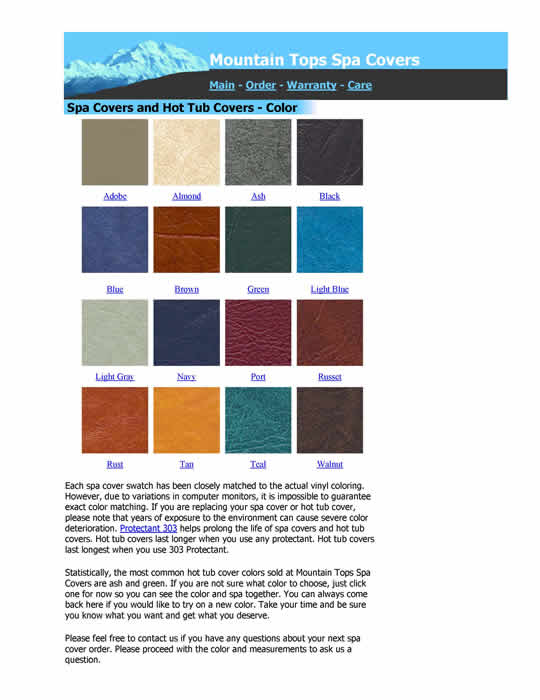
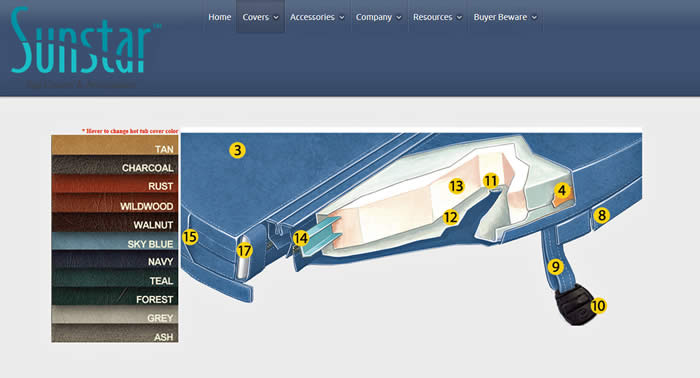
bromine and is available in 10 colors (see below). |
| |
4 |
Gusseted, double stitched skirt in a
variety of lengths. |
Provides a good thermal seal, and protects the lip of your spa
from sun damage. |

The skirt of a cover is another of the many important parts.
It needs to properly protect the lip of your spa from the
damaging rays of the sun, and be strong enough to use for
lifting your cover. These cover's skirts are double stitched
into the cover for strength, and gusseted to provide the best
protection! One piece continuous skirts, which are easier to
manufacture, have many inherent problems as compared to skirts
that are gusseted (also called "slited"). Gusseted
skirts will hang much straighter and have less tendency to
bunch-up under the cover, preventing a proper seal between the
cover and the spa.
As the sun beats down on a cover, extreme heat can build up
between the skirt and the outer lip of the spa. This intense
heat can actually damage the outer lip of the spa. A gusseted
skirt allows this heat to escape, preventing heat damage from
occurring. The skirts are double sewn into the cover for extra
strength and strong enough to lift even the heaviest of
covers.

|
| |
5 |
Strong, reinforced handles for opening and closing the
cover |
Provides a handling point for the cover. |

Standard nylon webbing handle |

Optional vinyl covered handle. |
Unlike the handles on many covers which tend to be a great
weak point, these spa cover handles have been designed and
engineered to be one of the strongest! Handles are great when
the cover is new, but over a long period of time most covers
eventually get a bit heavier. Cover handles, having such a small
attachment area can be easily torn off, sometimes tearing the
cover. Our cover's handles are made of extremely strong,
1-1/2" wide nylon webbing. Additional stitching, and
internal reinforcing make them some of the strongest available.
One of the many options offered, is to have the nylon handles
vinyl covered.
On the underside of the cover there are two additional
handles attached to the continuous "hinge seal". These
handles help in maneuvering the cover on and off the spa in
tight areas.

|
| |
6 |
20 gauge galvanized steel, 2.5" wide C-channel support beam |
Provides increased strength against snow-loading &
discourages foam sagging. |

Running the entire length of each piece of foam, along the
hinge is a 2½" wide, 20 gauge galvanized steel
C-channel support beam. This is the heaviest gauge
(thickest) reinforcement beam used in the industry, others tend
to be 22 to 26 gauge. Galvanized steel is used for it's
increases strength over aluminum, and also because of it's
greater resistance to chemicals (chlorine and bromine).
C-channel is much stronger than lesser expensive T-bar others
may use.
If the possibility of this C-channel rusting has
been made a concern to you, it really shouldn't be. The only way
for this C-channel to rust is if the vapor barrier surrounding
the foam is broken. If this happens the foam core of a cover
will absorb water (getting heavier and heavier) long before the
C-channel loses any integrity. |
| |
7 |
6 mil., single-extruded, virgin bead,
polyethylene vapor barrier on EPS foam cores with
optional double wrap. |
Inhibits foam-core moisture absorption |
One of the many important features of an
insulating cover is the vapor barrier surrounding the foam. The
barrier used in our covers is a 6 mil.
single-extruded, virgin bead, polyethylene sheeting. This extra
thick sheeting is heat sealed around the foam core. As an
added feature the sheeting is vacuumed of air during the sealing
process. This prevents the cover from "bloating" from
any trapped air expanding, when the sun beats down on it. Many
cheaper cover manufacturers tape the poly sheeting closed to
save costs, but eventually the tape fails and the cover will
start absorbing water, getting heavier and heavier.
One of the options offered on these covers is to double wrap
the foam core with a second layer of polyethylene sheeting. This
is something no other manufacturer offers and we highly
recommend it due to the following.
Covers have a small hole on the bottom side of the vinyl
covering to allow any accumulated water and condensation to
drain out. As much as this is an absolute necessity, it also
allows evaporating chemicals to rise up into the covers interior
(needless to say covers with an open mesh bottom are the
worst). Over a long period of time these chemicals can start
deteriorating the vapor barrier to a point where it becomes
porous. The porosity then allows steam and evaporating water to
penetrate into the foam insulating cores. One day science will
probably develop a better vapor barrier (although those wanting
to sell lots of covers may not use it), but until then doubling
up the polyethylene sheeting will extend the life of your cover. |
| |
8 |
4" x 2" Tapered, 1.5 lb. density, or 6"
x 4" Tapered, 1 lb. density virgin-bead expanded
polystyrene (EPS) foam core. |
Tapered for rain water run-off, Low center deflection value,
excellent strength while still light weight, and the highest R
value in the industry! |
The covers foam core is the "back
bone" of every spa cover. Not only is it the main
insulating factor, it also provides the strength needed for
years of use. One of the important features of our foam is that
it's a virgin foam, rather than recycled. While both may have
the same insulating value, recycled foam doesn't have nearly the
strength as the virgin foam we use.
The foam core of our Deluxe spa covers
are a 1.5 pound density, metal reinforced, EPS (expanded
polystyrene) foam , tapered from 4" to 2". The
foam core of our Extreme spa covers are is a 1
pound density, metal reinforced, EPS (expanded
polystyrene) foam , tapered from 6" to 4". The
taper is necessary to allow accumulated water to easily run off.
Many older, and some cheap covers are made of a flat foam which
will allow water to puddle,causing the cover to sag, allowing
more water to puddle, eventually breaking the cover.
Please note, these measurements are the true measurement of the foam itself. It is not a nominal
measurement, nor does it include the thickness of the vinyl or
vapor wrap (you'd be surprised how many others don't use a
"true" measurement, and add in thickness of the other
materials used).
Foam density refers to the weight of a cubic
foot of foam. A 1.5 lb. density is generally the ideal for a
4" thick cover. It has excellent strength and insulating
ability, yet is light enough to maneuver on and off your spa.
Lesser densities are NOT advised for a cover of this thickness
due to their lack of strength. With our 6" thick cover, a 1
pound density is more than enough. It provide almost 50% more insulation value over our 4" cover, is stronger, yet
is the same weight. Higher foam densities have additional
strength, but only slightly more insulating ability. One of the
many options we offer is upgrading to a higher density foam if
additional strength is needed.
With the standard 1 pound density foam cores,
the Extreme spa covers have a minimum insulation
value of R-21. The optional 1-1/2 pound density foam achieves an
even higher R-value!
The insulating core of almost all spa covers is EPS
(Expanded Polystyrene). The insulating value of this product
is very specific, and is listed in the table below.
Please note, the R-value shown is for 1 inch of thickness.
| Foam Density |
R-Value/in. |
| 1.0 |
3.85 |
| 1.25 |
4.0 |
| 1.5 |
4.17 |
| 2.0 |
4.35 |
Remember, all EPS foam of equal density has the same R-value!
"What is the R-value of your cover"? While this is
the most common question asked when comparing covers, the answer
can be the most deceptive. The following, though rather lengthy,
explains insulation and R-value. The short answer to the R-value
of our covers though, is R-14½ with the Deluxe spa cover
and R-21¼ with the Extreme spa cover.
R-value describes a material's resistance to the
flow of heat. The higher the R-value, the slower heat will
travel or conduct through a material. Better insulating
materials tend to have better R-values.
Heat flows by three mechanisms: conduction,
convection, and radiation;
Conduction is the molecule-to-molecule
transfer of kinetic energy (one molecule becomes energized
and, in turn, energizes adjacent molecules). A cast-iron
skillet handle heats up because of conduction through the
metal.
Convection is the transfer of heat by
physically moving the molecules from one place to another. Hot
air rises; heated water thermosiphons; forced-air heating
systems work by moving hot air from one place to another.
Radiation is the transfer of heat
through space via electromagnetic waves (radiant energy). A
campfire can warm you even if there is wind between you and
the fire, because radiation is not affected by air.
R-values by definition, only measures an
insulation's ability to resist heat loss by CONDUCTION.
The above's relationship to spas is this;
heat from the spa water rises by convection and radiation.
As it rises it heats the underside of the cover, then moves
through the cover by conduction. Increasing the covers
R-value reduces, or slows the rate of conduction. There are also
two ways to reduce the rate of convection, the first being a
floating blanket, the second being our optional exclusive Reflex
Energy Shield used for the covers underside material.
R-value is a term coined by the FTC in response
to a need for a way to compare the relative effectiveness of
various forms of insulation. R-values are measured by testing
laboratories (ASTM), usually in something called a guarded
hot box. As air within the test hot box is heated,
convection takes place, causing the heat to rise. As the heat
rises it warms the underside of the foam where upon conduction
of the heat through the foam begins. The R-value is the ability
of the foam (or other material being tested) to slow this
conduction. Heat flow through the foam is calculated by keeping
one side of the material at a constant temperature, say 90°F
(32 °C), and measuring how much
supplemental energy is required to keep the other side of the
material at a different constant temperature, say 50°F
(10°.C)--
Various industries are required to have their
products R-value tested by ASTM under very exact testing
perimeters. One of the parameters of this test is the
temperature at which guarded hot box is heated to, AND
the temperature the other side of the test material is kept at.
Changing either of these temperatures will result in different
R-value results. Once again, certain industries are required to
use ASTM testing procedure and parameters. For these industries,
when they list their products R-value (such as R-20) it's
understood that the difference in temperatures of the testing
procedure is 40 degrees (or R-20 @ 40º). It's also acceptable
to list another R-value AS LONG as the temperature difference is
listed ALSO (i.e. R-40 @ 20º). Here's the relationship to spa
covers. SPA COVERS ARE NOT IN AN INDUSTRY REQUIRED TO HAVE
R-VALUES TESTED ACCORDING TO ASTM STANDARDS! When comparing the
R-value of a hot tub or spa covers it's important to ask what
temperature difference the R-value was calculated at. Our covers
are rated at a temperature difference of 40º (i.e. R-21 @ 40º). |
| |
9 |
Multiple layered, quadruple reinforced hinge |
Keeps this overworked area of the cover from failing
prematurely |

The hinge is one of the most worked parts of a cover, and on
cheap covers one of the first things to deteriorate thereby
letting steam and heat escape. First of all, our covers do have
a hinge (they're not simply two half covers sewn together), the
hinge is constructed of the same high quality vinyl as the rest
of the covers covering. Our hinge is also four layers thick and
is quadruple stitched for the longest life available.
With the current trend of cover lifting devises (which we
highly believe in) the hinge is one of the most worked parts of
a cover. This hinge is constructed of the same high quality vinyl as the rest of the outer cover. It is not simply two
halves of the cover sewn together, but is a one piece hinge,
double stitched into each half of the cover. One of the options
available is additionally reinforcing the hinge by adding an
extra layer consisting of the same 1-1/2" wide nylon
webbing the handles are made from. This upgrade consists
of a strip of nylon webbing running the entire length of the
hinge! While other covers hinges are their weakest point, this
nylon webbing reinforcement makes these hinges the absolute
strongest possible! |
| |
10 |
Continuous hinge seal! |
Fills the entire gap created by the hinge for increased
overall insulation value. |

These covers have a continuous insulated "hinge
seal" to prevent heat from escaping from an area most
people don't even think about. Most other covers have what are
called "fingers" or "steam sealers" (below).
These are two pads that are placed on the underside of the
cover, at the ends, between the two halves to prevent steam and
heat from escaping when the cover is installed on your spa. If
you turn one of these covers upside-down you'll actually see
that they also push the two insulating halves apart (below),
leaving as large as a one inch gap between the two halves. This
is equal to having a hole the size of a basket ball in your
cover, your INSULATING cover!

|
| |
11 |
Double laminated polyester scrim
underside or optional Reflex Energy Shield. |
Better energy efficiency, better deterioration resistance than
vinyl, mesh, or even our double laminated polyester scrim liner. |

The underside material of the cover that faces the spa's
water takes the most abuse. It's also the first line of defense
in preventing chemical damage and moisture infiltration, and
must be durable enough to withstand the constant dragging from
removing the cover from the spa. these covers use a12oz double
laminated, tight mesh reinforced, chemical and ozone resistant
scrim. This material is so strong (it's constructed similarly to
rip-stop- nylon) that it's used internally throughout the cover
to reinforce the double stitching.
As an option, the scrim can be substituted with Reflex
Energy Shield, a 12 oz scrim, coated with a highly
reflective, woven metallic material. One of the ways heat is
lost is that it radiates out in waves (see above on R-value for
a full explanation on insulation value and heat loss). The Reflex
Energy Shield gives our spa covers an advantages over other
spa covers. The reflective nature of the Reflex Energy Shield yields a reflecting dish effect that bounces these heat waves
back down into the water, thereby increasing the cover's
insulating ability.

Please note, excessive chemical use in the spa can
lead to the woven metallic material "blistering" from
the scrim. Excessive chemicals are the only thing to cause this,
and blistering or bubbling is not covered under warranty.
Covers with Reflex Energy Shield should be removed from
the spa for a minimum of 20 minutes when shocking. |
| |
12 |
Exceeds ASTM Standards! |
Many local building departments require spa covers to meet
ASTM standard F 1346-91 for a "manual safety cover".
These covers meet all know local municipal codes and
requirements. |
ASTM (American Society of Testing: and Materials) has
developed a standard for both swimming pool and Spa Covers. This
Standard, ASTM F 1346-91, establishes three separate cover
classifications;
- Power Safety Covers, typically found on swimming pools
- Manual Safety Covers, such as the spa insulating covers
and
- Other Covers, which do not serve as a barrier for children
under the age of five and do not qualify as a safety cover.
In order for a spa cover to meet the requirements for a
"Manual Safety Spa Cover" it must meet certain
requirements which include performance tests and labeling
requirements. Covers must be able to pass tests such as
Static Load Tests for weight support, Perimeter Deflection Tests
for entry or entrapment between the cover and the side of the
spa and Surface Drainage Tests to see if a dangerous amount of
rain could collect on the covers surface. There are also
requirements to include labeling in consumer information (such
as the warranty), and on the cover itself. Labeling must contain
the proper warnings, and identify the product as a safety cover.
Non-safety covers can meet ASTM standards if they comply with the
labeling requirements for "other covers". If a covers
labeling does not say "safety", then
it only meets non-safety cover standards. In order to
legitimately bear a safety label, a cover must be able to pass
the tests that satisfy the performance standards of ASTM F
1346-91. |
|